Vol. 1 Chapter 2.2 – Early June, 1566
by PinkPanther“Hmm, I installed five of them, but only three have active colonies.”
Shizuko muttered as she inspected the beehive.
The inside was completely empty, with no sign that a queen bee had established a colony there.
Of the five hives she had installed, four had initially attracted colonies.
However, partway through, one of the queen bees had apparently taken a dislike to her hive, abandoned the partially constructed nest, and flown off somewhere.
Japanese honeybees were sensitive creatures, prone to abandoning their nests if they disliked even the slightest change in their surroundings.
The queen bee had probably noticed some tiny environmental change that humans would never have detected and decided to abandon the hive.
That was what Shizuko chose to believe. After all, dwelling on it would only leave her feeling frustrated.
“Well, can’t be helped. Oh, it’s almost sunset. I’d better hurry home.”
Looking up at the sky, she saw that the sun was already beginning to set.
Darkness descended earlier in the forest, so unless she hurried, it would soon become pitch-black, leaving her unable to see anything.
After returning the last hive to its original position, Shizuko began running along the path back to the village.
“If Wittmann were here, I could probably find my way home even in the dark…But he’s off looking for a wife right now.”
Wittmann, the wolf, had left the village in search of a mate when his mating season approached.
To be honest, she was uncertain whether he would ever return but she had nevertheless seen him off with a smile.
“Well, if he doesn’t come back…I suppose there’s nothing I can do about it.”
He was a wild animal to begin with, so she could hardly blame him if he simply wandered off somewhere and never returned.
Just as that thought crossed her mind, she heard a faint rustling sound—gasa-gasa—from somewhere a short distance ahead.
Instinctively assuming that a small animal was about to emerge, she made a small jump to avoid it.
“!?”
However, what emerged was neither a small animal nor a large one but a thick wooden club.
Already airborne, Shizuko had no way of adjusting her posture.
The wooden club struck her ankle, throwing her off balance in midair.
She landed on her shoulder, rolled across the ground several times and finally slammed back-first into a tree trunk.
“Kaha!”
The impact violently forced all the air from Shizuko’s lungs, leaving her on the verge of losing consciousness from lack of oxygen.
“Hehehe, it’s a woman.”
“A woman will fetch a fine price. Especially one as pretty as this.”
“Wandering around alone in a place like this…It’s practically asking to be attacked.”
However, the vulgar voices she heard before she could lose consciousness forcibly jolted Shizuko back to her senses.
Clutching her aching shoulder, she turned her face towards the source of the voices.
There were five men who appeared to be bandits. They were armed with spears, swords and farming implements such as sickles.
‘Deserters from the battlefield… Ashigaru, perhaps?’
That was her initial thought but since none of them wore any armour, she figured they were probably farmers who had been caught up in the fighting.
“Oi, don’t you dare make a sound.”
Before Shizuko could say anything, one of the bandits thrust the spear in his hand against her throat.
She understood the unspoken threat perfectly well. If she made a commotion, he would run her through without hesitation.
“Heheh, it’s been a while since we’ve had ourselves a woman. Let’s have our fill of fun with her before selling her off.”
After sheathing his sword, one of the bandits approached Shizuko with a lecherous grin.
And just as the bandit, who reeked of a stench foul enough to make one’s nose curl, reached out to strip off Shizuko’s clothes—
With a sudden gasari as something burst through the undergrowth, the man vanished.
Seeing their companion disappear right before their eyes, the bandits were thrown into utter confusion.
One of them, frantically looking around in every direction, finally caught sight of what had caused his companion to disappear.
“HIIIIH!”
“What’s wrong… W-What the hell is that monster!?”
Reacting to the man’s scream, the bandits all turned their gazes in that direction.
And just like the first man, they were immediately overcome with terror.
Despite wincing from the pain, Shizuko turned her head towards whatever the bandits were staring at.
Standing there was an enormous wolf, so large that it could only be described as gigantic, measuring nearly 140 centimetres from head to body.
Near the wolf lay the bandit who had been standing in front of Shizuko.
His neck had been twisted at an unnatural angle, and he was bleeding profusely.
The wolf had bitten into the man’s neck from the side and effortlessly snapped it with the sheer strength of its jaws.
With a bite force of as much as 180 kilograms, a wolf could probably crush the bones of people from this nutritionally deprived era with ease.
Yet, despite looking at a creature that could only be described as a monster, Shizuko strangely felt no fear.
She knew the wolf’s name.
“…Wittmann?”
She instinctively knew that this was the wolf who had lived with her.
She had no definite proof but she could not help believing it was him.
And as though answering her, the wolf let out a single bark.
Upon hearing it, the bandits dropped the weapons they had been holding.
People of this era generally stood less than 150 centimetres tall.
Even among samurai commanders, who enjoyed relatively good nutrition, reaching 160 centimetres was considered fortunate.
When confronted with a wolf whose shoulder height alone approached eighty centimetres, one could hardly help but sense death looming before them.
Furthermore, darkness had already enveloped the surroundings, leaving visibility practically nonexistent. Defeating a wolf capable of seeing in the dark would be an exceedingly difficult task.
The wolf let out a thunderous bark at the panic-stricken bandits.
Then, from another direction, a second wolf emerged, accompanied by the rustling sound of undergrowth being pushed aside.
It was slightly smaller than the first wolf, but its size was still sufficiently imposing.
Its most distinctive feature was a scar resembling an X-shaped mark on its forehead.
“H-HIIIIIIH!”
With the appearance of the second wolf, the bandits, now completely cornered, scattered and fled in every direction like frightened spiders.
The wolves did not pursue them. The fleeing bandits hardly seemed worth the effort of chasing.
It was obvious enough which side had emerged victorious.
“Welcome home, Wittmann.”
As though responding to Shizuko’s quiet words, Wittmann gave a soft bark.
Naturally, when Wittmann and his mate entered the village, an enormous commotion broke out.
Having two wolves of such extraordinary size suddenly wander into the village was enough to send anyone unfamiliar with them into a panic.
Expecting people not to be startled would have been asking the impossible.
However, it was mostly the newly arrived settlers who were shocked. The original villagers merely regarded the situation as yet another case of『The Village Chief must have done something again.』
Perhaps thanks to having been trained by Shizuko for an entire year, the villagers had become so unflappable that their lack of concern bordered on insensitivity.
Although the sun had already set and night had fallen, Shizuko could hardly ignore the settlers’ anxiety, so she found herself having to explain Wittmann’s circumstances to them.
After an hour of explanation, the settlers finally accepted what she told them, although that did not mean their fears had been completely dispelled.
‘I suppose I’ll just have to put up with it for a while.’
Expecting everyone to accept everything immediately was an unreasonable demand, little more than wishful thinking bordering on fantasy.
There was no solution other than letting time resolve the matter. Understanding this, Shizuko decided there was no point dwelling on it.
However, unbeknownst to Shizuko, the settlers had begun reassessing their opinion of her.
Until now, they had regarded her as nothing more than an unreliable young girl. But after seeing her commanding two wolves, they began to wonder, 『Could she actually be someone extraordinary?』
Since failure would mean beheading regardless, the settlers decided to entrust their last chance to her. Unlike before, they began approaching their work with genuine enthusiasm.
Some time after this change in the settlers’ attitudes, the rice seeds had completed their germination treatment and were ready for sowing, so Shizuko proceeded with the next stage: seeding.
For this, they used the land that had been prepared back in late February, spreading the rice seeds evenly across its surface.
The seedlings grown there would later be transplanted into the actual rice paddies.
As expected, the settlers still wore puzzled expressions, but unlike before, they obediently followed Shizuko’s instructions.
There was now a little time to spare while the seedlings grew.
Rather than waste that time, they began preparing the rice paddies for transplanting.
First came the initial shallow ploughing, known as araokoshi. After that, water was introduced into the paddies for the first rough puddling, called arashirokaki. Several days later, they carried out the final puddling, known as ueshiro-kaki.
By the time these procedures were completed, the seedlings had grown to a sufficient size.
The next stage was the most important of all: transplanting the rice seedlings, using rice bran in the process.
This was the critical stage and the thoroughness with which the transplanting was carried out would have a considerable impact on the final harvest yield.
There would be no point in raising healthy seedlings if they became complacent and neglected the transplanting process, only to end up with a harvest so pitiful it amounted to little more than a drop in the bucket.
Naturally, none of the villagers knew the methods considered standard practice for transplanting rice seedlings in modern times.
Here, Shizuko employed a method known as seijoue or regular-row planting, in which rice seedlings were transplanted in neatly aligned horizontal and vertical rows.
At the time, farmers did not use this planting method. Instead, they employed a technique known as『random planting』which often resulted in poor harvest yields. In particularly severe cases, the rice sometimes failed to grow altogether.
However, simply replacing random planting with regular-row planting could dramatically increase the harvest yield.
This was because the method offered several advantages: the rice plants received sufficient sunlight, air could circulate more freely between them and weeds and insect pests could be removed more easily.
Incidentally, this technique was not introduced until the latter half of the Meiji 30s (1897–1906), meaning Shizuko was implementing agricultural technology approximately three hundred years ahead of its time.
Its effectiveness, however, was tremendous. From then on, regular-row planting became such a widespread practice that it could be considered one of the fundamental techniques of rice cultivation.
Nevertheless, the method was not without its drawbacks.
First and foremost, rice-transplanting machines did not exist during the Sengoku period. Yet regular-row planting required seedlings to be positioned accurately along both horizontal and vertical lines.
Shizuko’s solution to this problem was to use a tool called a『waku-mawashi』or rolling planting marker, to mark the exact planting positions beforehand.
As its name suggested, rolling the waku-mawashi across the paddy left marks in the soil indicating precisely where the rice seedlings should be planted.
However, if they rolled the waku-mawashi directly through the paddy, the mud would cloud the water, forcing them to search for the planting positions despite having already marked them.
To solve this problem, Shizuko prepared long ropes that could stretch from one end of the paddy to the other.
She then used the waku-mawashi to determine the planting positions and tied pieces of straw to the ropes wherever they intersected with those points.
This way, the straw would serve as markers, allowing the farmers to identify exactly where to plant the seedlings without having to search beneath the water.
However, even after the seedlings had been transplanted, the work was far from over. They still needed to scatter rice bran across the paddies.
There were three reasons for applying rice bran.
The first was to suppress the germination and root development of weeds through the organic acids produced during decomposition and fermentation.
The second was to encourage the proliferation of microorganisms.
The third was to supply nutrients to the rice plants through the increased microbial activity.
These were its three primary purposes.
Once the rice transplanting was complete, all that remained was applying Hosen Yuki and carrying out the weeding.
Hosen Yuki is a fermented fertiliser made by mixing soil, rice bran, deer entrails, chicken entrails, bone meal, rotten meat, rotten vegetables, chicken feather shafts and beneficial microorganisms.
This created an environment in which soil microorganisms could function more effectively. As a natural slow-release fertiliser, it was particularly suitable for use as a basal fertiliser in paddy rice cultivation.
However, since it had to be applied according to the condition of the rice plants, the quantity used and the number of applications would vary depending on the paddy.
Still, fertiliser application was relatively manageable, as it only needed to be carried out intermittently based on experience.
The most labour-intensive task after transplanting was weeding. Despite demanding gruelling physical labour, its results were not readily visible.
To address this, Shizuko decided to employ a rotary paddy weeder, a device that could be rolled between the rows of rice plants to uproot the weeds growing in the paddies.
Naturally, such a tool did not exist during the Sengoku period, so Shizuko worked together with the village craftsmen to develop one.
The prototype of the rotary paddy weeder was created during the Meiji period and by the beginning of the Taisho period, it had come into widespread use.
It was an excellent device capable of covering approximately twenty ares per day, performing intertillage and weeding as it rolled between the clumps of rice with a rattling sound.
Intertillage referred to the practice of shallowly cultivating the surface soil while crops were growing to promote their development.
By stirring and loosening the soil, oxygen could reach the roots more easily, encouraging respiration and root growth.
It also promoted the absorption of fertiliser. Furthermore, harmful gases trapped within the soil, such as hydrogen sulfide and methane, could escape, while weeds could be controlled at the same time.
In short, once rice transplanting was complete, intertillage and weeding would become the primary tasks until harvest time.
It was also one of the most physically demanding aspects of rice cultivation.
Since the tool was essential for improving work efficiency, Shizuko refused to compromise and developed one that would maximise productivity.
The first round of intertillage and weeding was carried out seven to ten days after transplanting, once the seedlings had firmly established their roots.
After that, the process would be repeated twice more at ten-day intervals. Although there were relatively few rounds, each session involved extremely demanding labour.
Then, one day in June, when intertillage and weeding were all that remained to be done…
The female wolf Wittmann had brought back with him, whom Shizuko had named Balti, gave birth to five pups.
It was the first day that new life had been born in the village.
“So cuuute!”
Looking at the wolf pups, whose eyes had finally opened, Shizuko broke into a warm, delighted smile.
Naturally, Balti would become angry if she tried to pet them or stared at them too closely, so Shizuko kept a considerable distance between herself and the pups.
It would be another week or two before they could move around freely, but even so, watching the little wolf pups turn their heads this way and that as they curiously surveyed their surroundings was enough to make her expression soften.
“So cuuute!”
Shizuko was eagerly looking forward to the following week.
However, there was someone who was not at all pleased about that.
It was Wittmann. He had spent nearly a year by Shizuko’s side, receiving all her affection. Naturally, he was none too pleased to see that affection being directed towards his children instead.
He rubbed his body against her and licked around her mouth, doing everything he could to show her how much he adored her. However, it seemed his attempts to reclaim her undivided affection were unsuccessful.
Although Wittmann normally made the vocalisations of a wild beast, on this particular occasion, he was letting out pitiful little whines like a puppy.
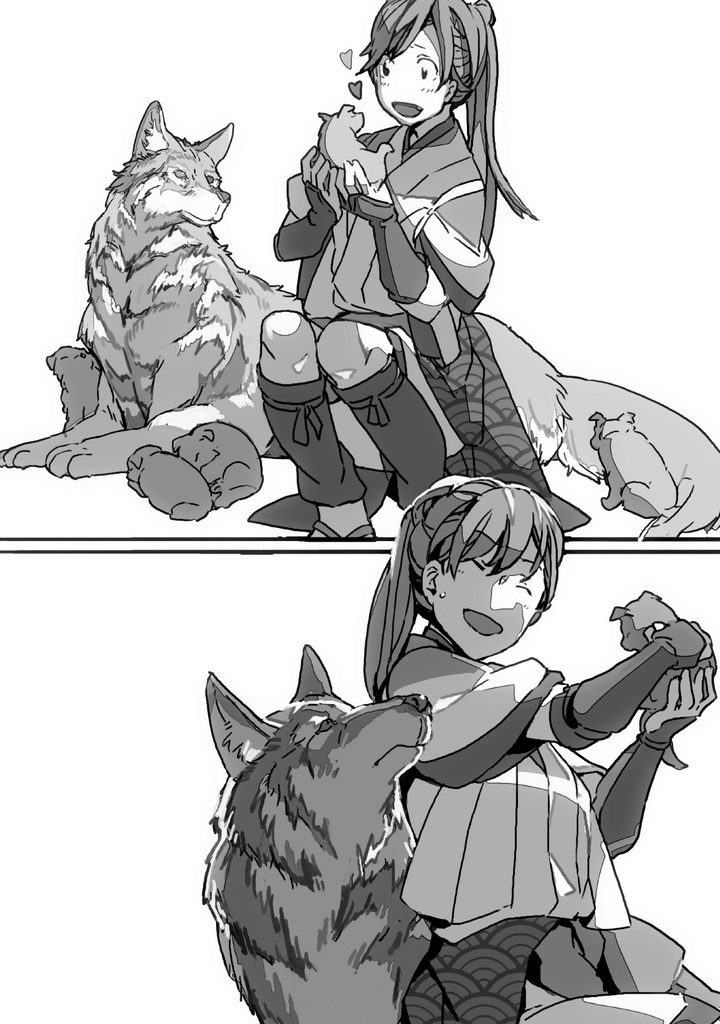
“Okay, okay, you’re adorable too, Wittmann~”
As though responding to Wittmann’s efforts to show how much he loved her, Shizuko said this while giving his head an almost excessive amount of affectionate petting.
That alone was enough to send Wittmann’s tail wagging furiously but the problem was that he was rather enormous.
With a tail measuring several dozen centimetres long, swinging it around like that was enough to turn it into a minor weapon.
“W-Whoa! I know you’re happy, so calm down~!”
Sure enough, he ended up knocking over everything around him.
And when Wittmann let out a sorrowful whine after being scolded by Shizuko, Balti responded with a sound that almost resembled laughter.
June came to an end and the season moved into July.
The villagers, who had initially struggled to get accustomed to the rotary paddy weeders, had become so proficient with them by the latter half of the work that they could finish the task in roughly a single day.
By July, the weeding work was almost complete. Most of the remaining work involved pest control.
After all, the paddies were now densely filled with magnificent, flourishing rice plants. Every single villager had remarked,『I’ve never seen so many rice ears growing together before.』
It was easy to envision the enormous harvest that awaited them.
However, pest control was not the only task remaining.
First came ditch cutting, which involved digging drainage channels at intervals of two to three metres.
These channels would make water management easier throughout the remaining period until harvest, so it was a task that could not be neglected.
Since the number of tillers was said to reach its peak around thirty-five days after transplanting, they also needed to carry out a soil-drying process known as nakaboshi or doyoboshi.
Using the drainage channels, they temporarily drained the water from the rice paddies.
The purpose of doyoboshi was to suppress excessive tillering and unproductive tillers, supply oxygen to the soil, and allow the remains of dead microorganisms to serve as nutrients.
It also helped firm up the soil to prevent the rice plants from falling over, while creating cracks in the ground to establish an aerobic environment, halt putrefactive fermentation and prevent the generation of methane gas.
Furthermore, the cracks stimulated the roots of the rice plants, encouraging them to shift from shallow, surface-oriented root systems to ones that extended deeper into the soil.
These were among the benefits they could expect from the process.
‘Reducing nitrogen should naturally help keep stink bugs under control, too~’
When it came to rice pests, stink bugs were among the foremost concerns. However, stink bugs were said to be less likely to appear when pesticides were not used.
This was because rice plants that had absorbed nitrogen were said to become a veritable feast for stink bugs.
However, there was no way to obtain pesticides during the Sengoku period, so naturally, Shizuko had no choice but to practise pesticide-free, organic cultivation.
As a result, the natural predators of stink bugs also began taking up residence in the paddies.
‘Maybe I won’t actually need to do much pest control after all?’
Even if organisms harmful to rice plants settled in the paddies, their natural predators would likewise establish themselves there to feed on them.
Of course, it goes without saying that removing weeds was the most effective measure against insect pests.
They thoroughly removed weeds not only from within the paddies themselves but also from the embankments surrounding them.
The weeds they collected were then used as materials for producing leaf mould.
A well-balanced cycle had been established within the rice paddies, allowing everything to be utilised without waste.
Then, one day in August, when weeding had become the primary task remaining before the harvest, Nobunaga, who had remained inactive until then, finally made his move.
In August of Eiroku 9 (1566), Nobunaga crossed the Kiso River and invaded Mino.
When Shizuko received news of this, only one word came to mind: 『Defeat』.
‘If I remember correctly, his forces were caught in a flood and forced to retreat. After that, he had Hideyoshi construct fortifications at Sunomata, a strategic location on the border between Mino and Owari. That became the forward operating base for the all-out assault on Inoguchi and Inabayama Castle, the stronghold of Saito Tatsuoki.’
Although Shizuko recalled these events, there was little point worrying about something whose outcome she already knew.
Having reached that conclusion, she lightly shook her head to drive those thoughts away.
Shifting her attention back to the present, she gazed at the rice plants stretching out before her and nodded in satisfaction.
“Mm-hmm, they’re growing nicely. At this rate, I should be able to achieve the harvest yield I originally planned for.”
To be honest, Shizuko had been somewhat worried about managing eight hectares of farmland with only a few dozen people but they had somehow managed to make it all the way to the final stage before harvest.
Even so, the sight of so much flourishing rice did not put her completely at ease.
‘Knowing Oyakata-sama, he’ll probably come up with some ridiculously unreasonable demands around this time next year…’
By this time next year, Oda Nobunaga would have brought Mino under his control. Once that happened, he would possess territories encompassing both Owari and Mino, with a combined agricultural production capacity of one million koku.
It was practically inevitable, rather than merely a prediction, that he would order Shizuko to increase production.
‘All the more reason I can’t wait for Kinzo-san to finish that manually operated rice transplanter I asked him to make. Once it’s completed, we’ll be able to transplant seedlings across ten ares in just three hours!’
Incidentally, Shizuko had no idea that Kinzo was currently clutching his head in despair after looking at the blueprints she had drawn for the manually operated rice transplanter (which were little more than crude doodles).
The manually operated rice transplanter, rotary paddy weeder and foot-operated threshing machine were all tools designed to reduce the burden of tasks considered particularly gruelling in agricultural work.
The difference in the time required to complete farm work with and without these tools was enormous.
Furthermore, they made it possible for women, children, and the elderly to carry out agricultural work, allowing those who did not go to the battlefield to handle farming duties.
That was how significantly these tools reduced the physical burden of labour.
With such equipment available, it would even become possible to divide the work in the fields and rice paddies among different family members.
“Now then, I suppose I’ll ask for about sixty hectares of vast farmland next year.”
The current amount of land devoted to vegetables and sweet potatoes was already sufficient.
The spring vegetables they had harvested had been well received, not only by the farmers but also by Nobunaga, to whom she had presented some as offerings.
However, rice was still the crop that mattered most when it came to supplying the battlefield.
Once Nobunaga secured Mino, the frequency of his military campaigns would increase, so he would undoubtedly order her to expand production even further.
Whether rice was available in abundance would make a considerable difference to the food supply of his soldiers.
“The egg-production business is going smoothly, too… Though I have a feeling Kaiser and the others might end up attacking the chickens.”
Kaiser was one of the wolf pups born to Wittmann and Balti.
Two months had already passed since their birth, so the pups had developed an awareness of social behaviour and had finished weaning.
They were approaching the age when they would begin venturing away from their den, which was Shizuko’s house.
A hierarchy had already formed among the pups, and Shizuko had named them according to their respective ranks: Kaiser, König, Adelheid, Ritter and Lutz.
The names represented the ranks of emperor, king, nobility, knight, and warrior, respectively. Since their parents had German names, she had simply given the children German names as well—a rather unimaginative naming scheme.
“Well, I’ll deal with that when the time comes. They need to hunt occasionally or they’ll lose their edge.”
Although their living conditions were close to those of domesticated animals, wolves would naturally become more inclined to go hunting once they had a family of their own.
Of course, Shizuko would have no objection if they hunted wild deer. However, she certainly could not afford to let them prey on the chickens she was raising for egg production.
“I guess I’ll just have to teach them properly from the time they’re little.”
Even so, she suspected that a few chickens would inevitably end up becoming casualties.
Imagining what the future might hold, Shizuko let out a heavy sigh.
[Rice bran is the nutrient-dense hard outer layer of a rice kernel, produced as a byproduct during the rice milling process]
[Waku-mawashi (枠まわし) is a traditional Japanese agricultural tool used to mark evenly spaced planting positions in rice paddies. It is essentially a wooden rolling frame that farmers push across a prepared paddy. As it rotates, it leaves a grid of impressions in the mud, indicating exactly where each rice seedling should be planted.]
[Nakaboshi (中干し) — Midseason drainage
A rice cultivation technique in which water is temporarily drained from a paddy during the rice plants’ growing period, allowing the soil to dry and firm up.
Doyoboshi (土用干し) — Midsummer paddy drying
A traditional term for drying rice paddies during the summer Doyo period, traditionally associated with the hottest part of the year.]