Vol. 1 Chapter 2.12 – Mid-December, 1566
by PinkPantherBy mid-December, when the biting cold had begun to seep into one’s bones, a certain fixture was finally completed in Shizuko’s house.
“Ta-dah! An irori!”
“You seem to be enjoying yourself, Shizuko-sama.”
It was an irori.
An irori was a type of hearth permanently built into the interior of a house, used mainly for heating and cooking.
In older times, it was also called a hitaki or jihiro and it was something found in virtually every traditional Japanese home.
An irori served many purposes: heating, cooking, lighting, drying clothes and freshly cut wood, improving the durability of the house through wood tar, and even providing a place for family members to gather and converse.
It was an extremely useful fixture but Aya’s reaction was rather muted, unable to keep up with Shizuko’s excitement.
“Boo, boo. What a weak reaction. Still, now we can finally endure the winter cold.”
The house itself had been completed fairly quickly, but only the irori had taken longer because they had lacked the necessary materials.
Because of that, Nobunaga had apparently scolded those involved in the construction more than once.
“More importantly, Shizuko-sama. What is that?”
Far more interested in something else than the irori, Aya pointed toward it as she asked Shizuko.
There stood something made of wood that looked like a long, low chair.
It was long enough that even if Shizuko lay down on it, there would still be plenty of room left over and if Aya lay down on it, nearly half of it would remain unused.
However, Aya was unfamiliar with low chairs like that—or rather, she could not even imagine what it was supposed to be used for.
“That’s a zaisu. It has a backrest, so it’s actually pretty comfortable.”
“A zaisu…?”
“Ah… I suppose it’s somewhat similar to a shogi? But this one is a chair you sit on while leaning against the backrest, so it’s a little different.”
A shogi was a simple portable stool often used at shrines, wedding halls and similar places.
It was made by crossing two legs into an X-shape, stretching leather or cloth across the upper ends to form a seat, and folding it up for carrying when moved.
Chairs did not become widespread in Japan until the Meiji era, so shogi were commonly used well into the early modern period.
Even today, one can occasionally still see them.
It was possible to attach a backrest and the like but as a rule, nothing more than a footrest board was usually added.
The reason was that if there were a backrest, then in the event of an attack from behind, one extra movement would be required compared with a seat that had none.
It was only a slight difference in time but that small difference could potentially mean the boundary between life and death. For that reason, backrests were generally not attached.
“And if you lie down like this, behold—a simple sleeping place! Ahh… comfortable, so comfortable.”
Having turned the zaisu into a makeshift bed, Shizuko rested her head on a zabuton—or rather, something like a pillow—made using precious cloth.
The filling was made from chicken feathers, so it was not as comfortable as cotton but considering that this was the Sengoku period, it was still unquestionably a luxury item.
“I see… Wait, please don’t sleep in a place like this. If you’re going to sleep, then properly… Ah, honestly! You’re drooling!”
With the warmth from the irori, the makeshift bed provided by the zaisu and the comfort of the soft, fluffy pillow, Shizuko promptly drifted off to sleep.
She remained in dreamland until Aya resorted to the ultimate drastic measure—kicking her off the zaisu.
Once the irori had been completed, Shizuko began spending most of her time in that room.
Unless she had some particular business to attend to, she would simply pass her days warming herself beside the irori.
Naturally, Aya also began centering her activities around that room, and as a result, the two of them spent much of their time shut away indoors.
But they were hardly the only ones doing so. It was much the same everywhere.
Normally, the villagers worked from sunrise until sunset, but during winter alone, their working hours became considerably shorter—from just before noon until about an hour before sunset.
The women who handled household chores began somewhat earlier, but they used lukewarm water from the hot springs for washing clothes and meals increasingly consisted of simple soups and other dishes that were easy to prepare and warmed the body.
The men behaved similarly, avoiding contact with cold water whenever possible and taking baths after farm work to warm themselves up.
The villagers had already taken reasonable measures against the cold, but Shizuko wondered whether there was anything more she could do.
When the human body is exposed to a cold environment, thermoregulatory responses occur to prevent body temperature from falling, such as the constriction of peripheral blood vessels and shivering.
Along with this came various physiological and psychological burdens. Muscles became less responsive, making manual work more difficult, while the stress caused by the cold could wear down both body and mind.
After thinking about how to reduce those effects as much as possible, Shizuko came up with two ideas, 『post-bath stretching』and『Radio Taiso』.
Stretching after soaking in a bath for a while helped loosen and extend the muscles, making the body more flexible, while activating the parasympathetic nervous system and producing a relaxing effect.
Keeping the body flexible in particular helped prevent stiff, awkward movements, while also reducing problems such as lower-back pain and chills caused by poor blood circulation.
Performing Radio Taiso No. 1 in the morning improved blood circulation to the brain, stimulated the nervous system and helped shake off drowsiness and fully awaken the mind.
Moreover, in only three minutes and ten seconds, it incorporated thirteen different movements capable of stimulating more than four hundred muscles.
It combined elements of aerobic exercise, strength training, stretching, and balance exercises, allowing the muscles and joints to be moved effectively.
When continued regularly, it could strengthen the『skeletal muscles』that played important roles in producing body heat and maintaining posture, while also promoting blood circulation and increasing basal metabolism.
In truth, every part of the routine had been remarkably well thought out.
Shizuko introduced both practices to the villagers but as always, most of them were skeptical at first.
However, after continuing for one or two weeks, the effects gradually began to show. Other villagers who heard about the results started imitating them, and before long, everyone in the village was doing Radio Taiso in the morning and stretching after bathing in the evening.
“…Hup. Phew, I can bend a lot farther now. And this gentle warmth that spreads through you feels real nice.”
“I can bend even farther than you. Thanks to this, I sleep soundly at night too.”
“Hey, sorry! Could someone push on my back for me?”
Cheerful voices could be heard from all around Shizuko’s village, which was wrapped in a peace so tranquil that one could scarcely believe it belonged to the Sengoku period.
Every villager thought the same thing.
No—perhaps it would be more accurate to say that they wished for it.
That this peaceful time might continue forever.
Newly Written Side Story: An Examination of Ayanokouji Shizuko — Nobunaga’s Perspective
In mid-December, Nobunaga stood alone before a mountain of rice bales piled high inside a storehouse.
Near the bales, several large chunks of rock had been placed haphazardly.
Both had been delivered by Shizuko.
The rice bales had been submitted as tax, while Aya had reported that the chunks of stone came from granite that had blocked a road after a landslide caused by a recent storm, and which Shizuko had broken apart.
‘Hmph… Heh heh. Shizuko is no mere braggart skilled only at running her mouth. Nor does she possess the sort of mind one would ever find in some boar-headed warrior concerned with nothing but martial prowess.’
Nobunaga gently ran his hand across the fractured surface of one of the stone blocks.
After having craftsmen examine it, one fact had become clear.
The method Shizuko had used to split the rock was something none of the stonemason groups could reproduce.
For days, the stonemasons had pondered how one might split rock without following its natural grain.
Yet in the end, not a single one of them had managed to devise a method that could actually be carried out.
The fact that Shizuko, who was not even a professional stonemason, had shattered the rock by a method that astonished even those specialists filled Nobunaga with an indescribable sense of fear—and an even greater surge of delight.
‘Shizuko’s way of thinking is fundamentally different from ours. Where did she cultivate that manner of thought… those values of hers? My curiosity knows no end.’
Of all Shizuko’s actions, what had surprised Nobunaga most was that even after he told her she could choose whatever reward she wished, she had not asked for land.
In the Sengoku period, when one spoke of rewards, the first thing that came to mind was a grant of fief land.
In an age of war, the one thing that guaranteed enduring value was land capable of producing crops.
That was common sense in the Sengoku period.
And just as the phrase issho-kenmei suggests, warriors had a tendency to cling with their very lives to land they had taken for themselves.
There had also been many retainers who rebelled because they had not been granted fief land.
‘But land is finite. And if a retainer’s ties to his land become too strong, there will come those who defy their lord’s commands.’
Standing before the rice bales, Nobunaga reflected upon this.
Perhaps Shizuko—who did not obsess over the amount of land or rewards she received and instead devoted herself to serving the lord who protected her—was precisely the kind of retainer he considered ideal.
Of course, Nobunaga himself believed that loyal retainers should be rewarded generously enough for their service.
Yet Shizuko had carried out such extensive development despite knowing full well that the territory was not hers but Nobunaga’s.
And even after all that, she had never pressed him to grant her a reward.
‘That girl does not even collect annual tribute from the peasants. Why? Does she truly have no greed at all?’
Nobunaga lightly tapped one of the rice bales before him.
He had brushed the matter aside in front of Mori Yoshinari and Kazumasu, but inwardly, Nobunaga was irritated by the fact that he could not see what lay at the bottom of Shizuko’s heart.
People fear what they cannot understand.
But Nobunaga could not allow himself to acknowledge that fear.
There were reasons he could not permit himself to do so.
‘As I thought, that girl is not one of the Nanban. She is something else entirely… It would almost make more sense to think she came from another world. Hmph… It seems I have become quite impatient without even realizing it.’
Dismissing his own thoughts as absurd nonsense, he closed his eyes and slapped both cheeks with his hands to rouse himself.
Then he turned his back on the rice bales.
‘It matters not what Shizuko truly is. She has shown me her talent. In that case, all I need do is keep the promise I made to her. And if I have misread what lies within her heart and Shizuko should betray me, then I need only make her regret ever having been born into this world.’
If an enemy possessed ability, he would make use of them.
If even a hereditary retainer turned against him, he would cut them down without mercy.
His ability to adopt such bold strategies, unlike other provincial lords, was one of Nobunaga’s greatest strengths.
Unlike moments before, there was no hesitation in Nobunaga’s steps.
That was because he had finally reached his answer regarding how he would treat Shizuko.
‘If Shizuko intends to do things that astonish me, then I shall enjoy them. Shizuko, astonish this war-torn age to your heart’s content. I shall take my pleasure in watching it all from close at hand.’
Imagining the turmoil that would surely come, Nobunaga’s smile deepened.
It was a smile so beautiful that the pages waiting nearby could only sigh—and yet so cold and merciless that it sent a literal chill down their spines.
Without realizing it, the pages trembled as fear took hold of them.
“We’re heading back.”
Ignoring the terrified pages, Nobunaga gave the brief command, turned his back on them and began to walk away.
A kosho was a young personal attendant or page serving a samurai lord, often handling close personal service and sometimes training for future military or administrative roles.]
[Irori (囲炉裏) is a traditional Japanese sunken hearth built into the floor of a house.]
[“Issho-kenmei” (一所懸命) is an old Japanese expression meaning to defend and devote oneself to a single piece of land with one’s life.]
[“Pages” here means 小姓 (kosho), not pages of a book.
Afterword (from the author)
To all readers of Earth Star Novel, it is a pleasure to meet you. My name is Kyouchikutou.
This work, Sengoku Komachi Kuroutan, is a published edition of the series of the same name that I have been serializing on Shosetsuka ni Naro, and I am very happy that it has now made its way into your hands.
The story is based on historical fact, with a healthy amount of convenient fiction woven into it and it began with the concept of『let’s have fun learning about all sorts of technologies』.
However, there is something I must make clear from the outset.
Because this work is set in the Sengoku period, the social standing of women is extremely low, leaving almost no room whatsoever for romantic-comedy elements.
Even when someone is talking about falling in love, it is usually just a man becoming completely devoted to another man and declaring,『Aniki, I’ll follow you for the rest of my life!』That sort of thing.
On top of that, the male-to-female ratio among the cast is 8:2, making this an overwhelmingly rugged, manly sort of light novel.
And that is why Aya, who was unpopular when the series was first being serialized, is in fact one of this work’s precious heroines. (Emphatically.)
Now then, allow me to explain a little about this work.
At first, I intended to develop it as an alternate-history novel focused heavily on agriculture but I immediately ran into a major problem.
It was far too plain…
In a light novel, the appeal of the characters is important but so is the story.
While Nobunaga is risking his life expanding his territory, the protagonist, Shizuko, is off farming as though none of it concerns her… That simply would not do.
So, in an attempt to add some flair to the story, I drew inspiration from the『Three Bs』used in the advertising industry to create appealing content, and from that came Wittmann and his family of gray wolves.
※The Three Bs are Beauty, Beast, and Baby. I pride myself on having devised the perfect plan combining the beauty of a wild beast with the cuteness of a baby. No one agrees with me, though.
I still fondly remember my closest friend mercilessly retorting,『Why aren’t they people!?』
To my surprise, readers received them rather favorably, and once I decided that instead of overthinking things I should just build up momentum and charge ahead, I found that things somehow worked themselves out.
My aforementioned friend sharply pointed out that this was『the way a hopeless adult thinks』but I simply bluffed my way through it.
The hardest part of turning the series into a published book was deciding what the characters looked like.
In fact, during the early stages, I placed little importance on the appearance of not only the protagonist, Shizuko, but also Nobunaga and Mori Yoshinari, and simply left it at,『I can decide that later』. I had created character-setting materials for writing purposes, covering things such as personality and background, so I completely forgot that I had never properly worked out their physical appearances.
When the time came to have illustrations drawn and I was asked to provide descriptions of the characters’ appearances, I looked back over my notes and was stunned to discover that there was no section on appearance at all.
And yet, for some reason, the notes for Wittmann and the other gray wolves were incredibly detailed…
If I had a time machine, I would like to go back and dropkick the version of myself who thought,『Eh, I can write that later』.
Hirasawa Geto-sama, thank you very much for creating such wonderful illustrations from nothing more than my vague and uncertain explanations. I sincerely hope I can continue to count on you from here on as well.
Also, this is merely a trivial personal matter but I am a writer with another full-time job.
During the day, I am what people commonly call a corporate slave.
I work my regular job during the daytime, do my best with writing at night and sometimes spend my days off shut away at home writing as well.
You may be thinking,『So what?』but as one corporate slave to others, allow me to offer a piece of advice.
It is wiser to avoid writing to the point that it begins affecting your main job.
If a workplace crisis suddenly lands in your lap on a day when you have pulled an all-nighter, it is absolutely miserable. (Speaking from experience.)
『Push through and keep writing without sleep』should be treated as a final resort when there is no other option.
If you do not take proper care of your health, you run the risk of failing at both.
To all my fellow aspiring writers, how about doing Radio Taiso with me?
Just a few minutes of exercise can leave you feeling surprisingly refreshed. (Laughs.)
Lastly, my thanks to my editor, to illustrator Hirasawa Geto-sama, to the printing staff and everyone else involved in publishing this book, and most of all, to you for picking up this book.
With those words of gratitude, I would like to bring this afterword to a close.
December 2015
Kyouchikutou
Afterword (from the illustrator)
Hirasawa here. Thank you very much for staying with us this far.
As of December, I’m writing this while shivering from the cold.
I read that during the Sengoku period, there was no such thing as what we would call a『cotton futon』. Instead, people wore padded kimono and slept on top of tatami.
It was an age when urbanization had not progressed as far as it has today, and then there were the cold early mornings—not to mention that traditional Japanese houses were full of gaps and drafts.
I couldn’t help thinking,『Just how cold must it have been?』
It was also written that commoners would burrow into straw and sleep inside it.
That sounds rough…
Please continue to enjoy watching Shizuko do her best in such a Sengoku period!
Hirasawa Geto
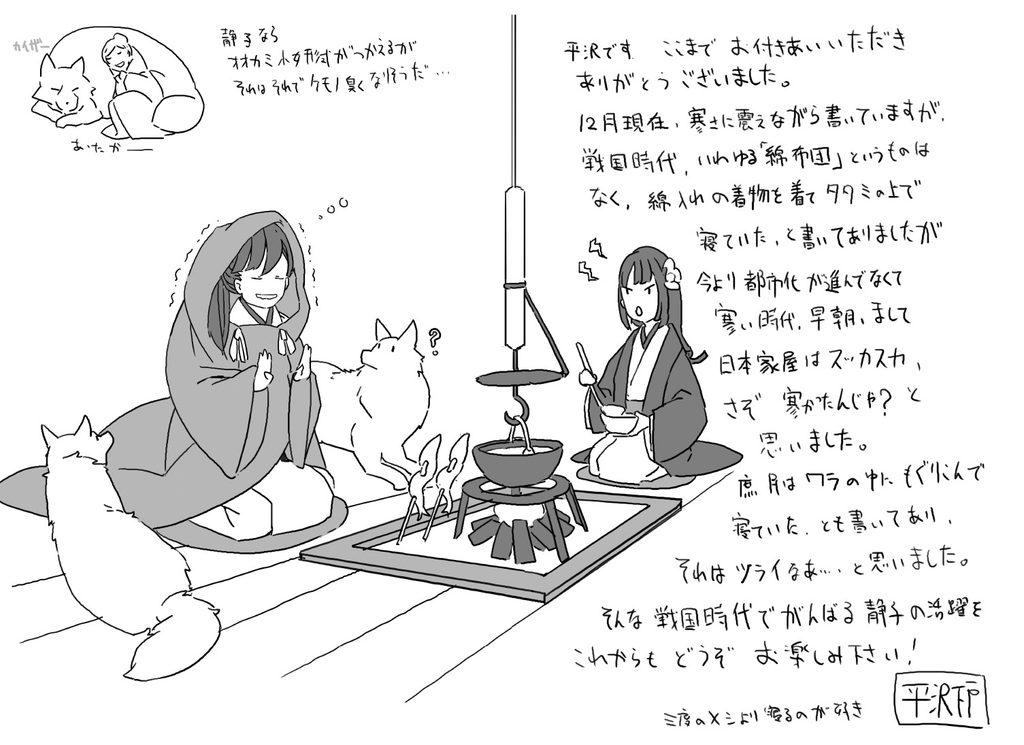
[Upper-left note]
If it’s Shizuko, she can use the『wolf-girl formation』 but then again, she’d probably end up smelling like an animal…
“Snore…”
“So warm…”
[Bottom note]
I like sleeping more than three meals a day.