Vol. 1 Chapter 2.11 – Early December, 1566
by PinkPantherThings became a little busier almost immediately after December began.
The soybeans and sugarcane had entered their harvest season.
The cultivated area amounted to one hectare of sugarcane and roughly fifty ares of soybeans, and a fine harvest could be expected from both.
The soybeans in particular had not been expected to yield much because there had been so little nitrogen fertilizer available, but contrary to expectations, they produced a bumper crop.
‘If I can gather enough nitrogen fertilizer, I could use Grandpa’s Special Cultivation Method and harvest four hundred kilograms per ten ares…Well, maybe next year or the year after.’
Shizuko had forgotten but soybeans were exceedingly valuable as feed for warhorses and could even be regarded as military supplies.
However, in her mind they were little more than ingredients for soy sauce and miso, so she greatly underestimated the value of soybeans.
“Hmm…We need salt to make miso and soy sauce, but… there’s no way we can get our hands on large quantities of it right now.”
In modern times, salt could even be bought at convenience stores, but in the Sengoku period, there was naturally no such thing as producing salt with ion-exchange membrane technology. Salt was produced primarily through methods that made use of salt fields.
Yet even with an enormous amount of labor poured into the process, the quantity of salt that could be produced was pitifully small—a mere sparrow’s tears.
‘Maybe I should modify a trickle-flow salt field a little and start producing salt on a large scale. Either way, the fact that we don’t have enough salt is a serious problem.’
Salt was fundamental as a seasoning and was also an essential ingredient for producing many other seasonings, so the more of it they had, the better.
Since it was not organic matter, it would not grow mold, nor did it contain nutrients on which bacteria could thrive.
Thus, even if they produced it in large quantities, there would be little difficulty in preserving or managing it. Put simply, all they had to do was fill jars or barrels with it and store them in a warehouse.
‘If we start producing rice in huge quantities, storage will become a problem too… But for that, I suppose we could build wooden silos. We might also need a facility for threshing and husking the harvested rice.’
She called it a facility but Shizuko was not imagining anything that required particularly mechanical equipment. What she had in mind was a place where the work could be carried out in a continuous flow, something like a conveyor-belt production line.
Fortunately, a waterwheel could provide the necessary power, so constructing such a line would not be especially difficult.
“Well, putting that aside… first comes the soybeans.”
Immediately after harvesting soybeans, they had to be dried in the sun. Before that, however, the harvested plants first had to be properly arranged.
Next came securing enough space.
Their small yard was already packed from end to end with things being dried under the sun.
There was plainly no way such a quantity would fit, so Shizuko decided to construct a long drying area in front of the house and dry the soybeans there.
Since it was close to the entrance, coming and going would become slightly inconvenient, but it would only last for one or two weeks, so they would simply have to endure it until then.
Once the beans had dried sufficiently for threshing, the next step was the full-scale threshing itself.
They spread a large cloth over the ground, then repeatedly smacked the soybean branches, pods and all, against the inside of a deep tub.
That alone removed most of the pods, but inevitably some stubborn ones refused to come off. Fragments of pods and branches also began accumulating.
That much was still tolerable but from some insect-eaten pods, larvae would wriggle out.
Dealing with them one by one would only waste time, so once enough had accumulated, everything was transferred into a broad, shallow tub.
From there onward, it became a battle of sheer manpower.
They sorted the soybeans from everything else.
At the same time, the beans themselves were separated into clean soybeans and those that had been insect-damaged or were otherwise unsuitable for eating.
Doing all of that alone would take far too long, so Shizuko divided the process into two stages: a first sorting to separate the soybeans from the debris and a second sorting to grade the soybeans themselves.
After spending yet another full day sorting everything, they ended up with approximately 480 kilograms of clean soybeans.
From those, she set aside the beans that would be used as seed for the following year, leaving a final total of 400 kilograms suitable for food.
The scraps and insects that had been removed were then used as ingredients for compost, to become fertilizer for the following year.
“Mufufu, that turned out pretty nicely. Next year, I’d like to harvest ten times this much.”
“I feel as though we would also need ten times the manpower…”
Aya spoke while looking somewhat taken aback at the tubs filled with the neatly sorted soybeans, while Shizuko wore a broad grin.
To someone who understood their true worth, it would have looked like a mountain of treasure, but to Shizuko, it was nothing more than a mountain of soybeans.
“All right, let’s use these to make miso and soy sauce.”
“Soy sauce…? Please do that after everything has been organized and half has been delivered to Oyakata-sama. And what exactly is that monster made of susuki grass…?”
“I know, I know. Next, we need to deal with the sugarcane. Let’s hurry up and make some brown sugar.”
With that, Shizuko began processing the last of the major harvested crops—the sugarcane.
Refining sugar required a fair amount of effort and manpower. Because of that, Shizuko decided to ask some villagers who appeared to have time on their hands to help with the work.
The sugarcane was not one of the varieties cultivated in Okinawa, but rather an improved variety developed from chikuto, the cane used as the raw material for wasanbon sugar. It grew to a total length of 2.5 meters, making it taller than the two-meter chikuto, while the stalks from which the sugar was extracted were also slightly thicker.
It was a variety capable of yielding one and a half times as much high-quality sugar as ordinary chikuto. However, because its overall crop yield was low to begin with, it was not well suited to mass production despite the excellent flavor of its sugar.
The method of extracting the sugar was much the same as with ordinary sugarcane. The stalks were finely crushed and their juice squeezed out, after which oyster-shell ash—made by burning shells such as oyster shells—was added as a settling agent.
The impurities would then settle to the bottom, allowing the clear liquid at the top to be drawn off and boiled down until sugar crystals formed.
In modern times, the mixture would be put through a centrifuge or similar equipment for further concentration, but neither such machinery nor any suitable substitute existed in the Sengoku period.
‘I could probably make something resembling a bicycle and do it that way… but whoever had to keep pedaling it would be in hell…’
It would probably be possible if they simply forced the mechanism to turn through brute strength, but there was no need to go that far, nor would the labor involved be worth it.
After all, even brown sugar would easily qualify as a luxury item in the Sengoku period.
“Village Chief! This juice is really sweet!”
“Be careful not to drink too much. Oyakata-sama will be angry if the amount decreases.”
Shizuko replied with a wry smile to the farmer who had muttered that after licking some of the pressed cane residue.
Since ancient times, alcohol and sweets had been treated as offerings to the gods and commoners rarely had the opportunity to taste them.
Even when they did, what they had were things such as boiled amazura syrup, starch syrup, or persimmon frost, none of which came close to sugar or honey in sweetness.
That said, unlike salt, sweeteners such as sugar were not essential seasonings needed for daily life.
Furthermore, fruit was far more common as a sweet snack, so refined sugar itself was closer to a luxury indulgence.
‘I seem to remember sugar being used as some sort of display of power or status?’
During the Sengoku period, Japan was unable to produce sugar domestically and relied almost entirely on imports from overseas.
The quality and color of the sugar at the time were unclear but during the Muromachi period, one kin of sugar—approximately six hundred grams—was priced at as much as 250 mon, making it an extraordinarily expensive luxury item.
Therefore, possessing large quantities of sugar allowed a person to demonstrate to those around them both that they possessed overseas connections and that they commanded enormous wealth.
“Village Chief, it’s starting to get kinda thick and sticky.”
“It should be about ready. Please transfer it into the containers we prepared.”
Once the liquid had been concentrated by evaporating away its water, all that remained was to cool and harden it, producing brown sugar.
After allowing the liquid being poured one after another into the molds to lose some of its heat, they moved the molds into a naturally chilled place that served much like a refrigerator.
Unlike refined white sugar, brown sugar contained minerals, and so, provided the amount consumed was properly controlled, it was a highly nutritious sweetener much like honey.
‘Considering the possibility of an emergency, I’d like to keep a certain amount of sugar in reserve.’
As she watched the liquid being poured into mold after mold, Shizuko considered how much of it she should store away.
Strictly speaking, sugar was not an essential nutrient.
If anything, living without consuming it was healthier.
If all one needed was energy in the form of simple 『sugars』rice and miso already provided more than enough.
For that reason, Shizuko primarily intended to use sugar as『medicine』.
Sugar actually possessed the property of drawing moisture out of foods and other substances, thereby suppressing the activity of microorganisms.
The idea of treating wounds by applying sugar to them might sound like some sort of joke, but an American physician had reportedly tested the method over a period of seven years and obtained a certain degree of effectiveness.
The reason was that the sugar absorbed moisture, suppressing bacterial growth and thereby preventing interference with the wound’s natural healing process.
Granulated sugar was supposedly the most effective, but brown sugar could also produce sufficient results.
She did not have enough sugar to use it lavishly in such a manner but she still wanted to keep a certain quantity on hand in case of emergency.
‘If I remember correctly, there was a record in the Shincho Koki that Chosokabe Motochika of Tosa (Kochi Prefecture) presented Oda Nobunaga with thirty kin—about eighteen kilograms—of sugar. If I use that as a reference, around three kilograms should probably be enough for an offering.’
While Shizuko was thinking about such things, someone called out to her.
“Shizuko-sama, may I have a moment?”
It was Aya.
Until now, she had remained silent because her mind had been struggling to keep up with everything she was trying to understand, and because she had been unable to find the right opportunity to speak.
At last, however, she had managed to seize her chance.
“What is it? If you want some sweets, I’ll make you some later.”
“That is not what I mean! Since when did I become such a glutton!?”
“O-Oh… Sorry. So, what is it?”
Indignant at having such a disgraceful label slapped onto her, Aya gave a small cough to regain her composure.
Then, lowering her voice so that only Shizuko could hear, she spoke.
“You said it was sugar… but is the juice you poured into those molds really sugar? I’ve seen sugar once before, but back then it was more like… a powder, wasn’t it?”
“Ah…”
Put simply, brown sugar was made by squeezing juice from sugarcane, boiling it down, then cooling and hardening it.
To Aya, the concentrated liquid in the middle of that process simply did not connect in her mind with what she knew as sugar.
“Once we cool it and let it harden, it’ll become the sugar you know, Aya-chan. You know that water turns into ice when you cool it, right?”
“That… yes.”
“It’s the same idea. Right now it only looks like juice because it still contains water. Once the water is gone, it’ll become the powdered sugar you’re familiar with.”
“I see.”
“Well, strictly speaking, there are more detailed steps involved in the manufacturing process but for an amateur like me, this is about as far as I can go.”
Shizuko scratched her head in embarrassment, but from Aya’s perspective, the fact that she could refine sugar at all was already astonishing.
Aya looked once more at the molds being carried into a dark place.
She could not estimate the quantity by sight alone, but there was no doubt that it represented a small fortune.
Aya began to wonder whether the place she had been sent to was, in fact, somewhere entirely different from the world she knew.
“For the last tribute of the year, I suppose it’ll be soybeans, brown sugar and dried goods like dried persimmons. Aya-chan, please check when it’ll be all right to bring those over.”
“…Yes.”
“Though we don’t have proper equipment for the brown sugar, and we’re still not used to making it, so the amount is probably a little small. Starting next year, we’ll have to improve the refining yield.”
Aya understood that she needed to report all of this but the real problem was the amount of tribute.
It was still unclear exactly how much brown sugar they would end up with but Shizuko did not seem to think there would be all that much.
What they knew for certain so far was twenty-five dried persimmons, fifty dried shiitake mushrooms, and two hundred kilograms of soybeans.
‘I just hope I don’t get scolded for reporting something like this…’
The sheer quantity of soybeans in particular was so great that Aya spent quite some time worrying over how exactly she should report it.
About a week later, just as the refining of the brown sugar had been completed and it was being packed into jars, a notice arrived from Nobunaga.
Its contents were twofold. Soldiers would be dispatched as escorts for transporting this latest tribute and not only Aya but Shizuko herself was to come to the castle as well.
Lately, Shizuko had been leaving everything to Aya, so it had been quite some time since she had personally gone to Nobunaga’s castle.
After completing all their preparations, the two set out and reached the castle without incident along the way.
As always, Shizuko was made to change into formal attire and have her appearance properly arranged. This time, however, unlike before, she was not left waiting in the audience chamber for an extended period.
After only a few dozen minutes, Nobunaga appeared in the audience chamber.
Though slightly surprised, Shizuko gave him the customary greetings.
“The tribute presented this time is truly splendid.”
Those were the first words Nobunaga spoke to Shizuko, a faint smile on his face.
Caught completely off guard by the sudden praise, Shizuko stared at him in stunned silence, but Nobunaga continued without concern.
“Dried shiitake mushrooms and sugar can be turned into war funds. Soybeans are necessary for feeding warhorses. Thanks to these, our army has been able to greatly strengthen its military power. They will no doubt become a major foothold in our campaign to conquer Mino.”
At first, Shizuko could not quite understand what he meant, but with those words, everything finally clicked into place.
Until now, most of the crops she had presented as tribute had not really qualified as military supplies.
Rice was the sole exception.
This time, however, the tribute of soybeans, brown sugar and dried shiitake mushrooms could all be regarded, for the most part, as military resources.
They could be sold for high prices and converted into substantial war funds, and at the same time, they could serve as status symbols through which one could display one’s own power and wealth.
Not only in the Sengoku period and not only in the East or the West, rare goods remained important items for displaying one’s wealth and power right up until the modern age.
In the West—Europe, for example—there were spices.
In late medieval Europe, spices such as pepper were so valuable that they were said to have been traded for their weight in gold.
Pepper in particular held the most important position among spices.
That was because pepper served three purposes: preservation, deodorization, and seasoning.
In the meat-eating culture of Europe, before the invention of refrigeration, it was practically a magical spice.
Yet at the time, pepper could only be cultivated in tropical and subtropical regions, and Europeans generally obtained it through trade with Muslim merchants.
Naturally, the greater the number of merchants involved as intermediaries, the more the price rose above the original trading price.
There were even stories of pepper being bought and sold for as much as sixty times its initial price.
As an aside, it is also said that one of the causes behind the beginning of the Age of Discovery was the fall of the Eastern Roman Empire to the Ottoman Turks in the mid-fifteenth century. With that, Europe lost established trade routes and means of passage involving Muslim merchants, cutting off its access to spices.
Of course, this was not limited to the West. The East—and Japan as well—was no exception.
In old Japanese cuisine, rather than taste, having the『appropriate color』for a dish was considered an important element.
There were, of course, dishes in the Sengoku period that were delicious to eat but the overall tendency was to place greater emphasis on appearance than on flavor.
For that purpose, valuable goods such as sugar, spices, and shiitake mushrooms were indispensable.
“They said no one could cultivate shiitake, yet you succeeded. Your skill is truly admirable. And your dried persimmons, another dried delicacy, were equally splendid. I care little for food myself but the dried persimmons you made were truly a feast.”
Nobunaga spoke while nodding, almost as though reaffirming the matter to himself.
Shiitake mushrooms had remained something far beyond the reach of ordinary people until 1942, when Dr. Kisaku Mori, a doctor of agricultural science, succeeded in artificially cultivating them after it had long been considered impossible.
There were methods of artificially cultivating shiitake even during the Edo period but they amounted to little more than making cuts in felled logs with a Nata in order to make it easier for shiitake to grow—a method that required an almost mind-numbing amount of patience.
If it succeeded, one could make an enormous fortune.
If it failed, however, it could ruin an entire household and scatter the family.
It was cultivation that amounted to the ultimate gamble.
“For your reward this time, I shall grant you whatever you desire. Name anything you wish.”
Nobunaga spoke in high spirits.
Even after being told she could have whatever she wanted, Shizuko could not immediately think of anything.
Yet if she declined here, she would only cause Nobunaga to lose face.
As a reward for the rice, she had already been given a fine house.
She also had Aya helping her as an attendant.
Beyond that, she simply could not think of anything else she personally wanted.
What she had failed to think of, however, was merely 『something she wanted for herself』.
“…W-With all due respect, Oyakata-sama, there is something I would like to ask of you.”
“I do not mind. Speak freely.”
“At present, our village is expanding its farmland. However, we are still lacking manpower. Therefore, I would like to borrow some laborers for approximately one month.”
Everyone in Shizuko’s village was working together to expand the farmland but since they had to carry out the work alongside their usual duties, the expansion was not progressing as much as she wanted.
From the villagers’ perspective, there was no particular problem.
Shizuko, however, wanted to expand the farmland until they had enough space to maintain a comfortable surplus.
In the Sengoku period, a poor harvest could easily leave people struggling to secure enough food to eat.
For that reason, any surplus crops needed either to be sold for money or preserved as emergency provisions.
“I would like approximately two hundred laborers.”
After saying that, Shizuko bowed her head.
She wondered if perhaps she had gotten a little too greedy but she judged that borrowing a large number of people all at once would be more efficient than making repeated requests little by little.
The fields they were about to create would serve as the basic standard size for the village’s farmland from that point onward, so she could not afford to cut corners.
Besides, she doubted there would be many opportunities when Nobunaga was in such a good mood and willing to hand out rewards so generously.
“You require that many people. There must be some reason for it, yes?”
“Yes. Last year and this year, the crops in our village were plentiful. But that will not continue forever. Someday, there will surely be a poor harvest. I am thinking of stockpiling emergency food so that we will not panic when that time comes. However, with our current yields, we cannot even build up the bare minimum amount of reserves we need.”
“…”
“I realize this is entirely for the convenience of our village but I ask for your indulgence.”
“Kukukuku, what an ungreedy girl.”
Rather than asking for territory, money, or valuables, she wanted manpower to expand her fields.
Nobunaga could hardly think of it as a reward at all, but since it was what she herself desired he had no intention of objecting.
“Very well. As you wish, I grant you the authority to make use of two hundred laborers.”
With a small laugh, he said those words to Shizuko.
After that, they exchanged a few more words, and her audience with Nobunaga came to an end.
All that remained was to return home, so Shizuko was about to leave the castle when Mori Yoshinari stopped her.
Apparently, he had some business with Aya. After saying a brief word to Shizuko, he took Aya away with him.
Shizuko had no pressing business and no particular need to hurry home, so she decided to wait for her.
After sitting down in a place where she would not be in anyone’s way, she used the ground to organize everything that had happened so far.
She had successfully secured two hundred laborers but matters would not proceed so simply.
They were not restoring already existing fields.
They would have to create farmland from nothing.
That meant she would need to make a proper plan. If she handled things poorly, she could end up doing nothing more than leaving two hundred people idle for an entire month.
‘..My ultimate goal is three hectares per farmer, but since we don’t have mechanization yet, let’s assign one hectare of farmland per farmer for now. We only have about eighty people at present…but that number is going to increase.’
There was another reason, besides producing preserved food, for expanding the farmland even further.
The original villagers had been living under Shizuko’s guidance for nearly two years, while the farmers who had been resettled there this year had been doing so for almost one year.
Various problems had arisen along the way but over those two years, the village had developed to a degree unlike anything else around it.
Now that their food, clothing and shelter had stabilized, the villagers had recently begun coming to Shizuko with similar requests.
They wanted to bring the family members from whom they had been separated to live in the village with them.
Many of them had effectively been forced to sell their children off to work elsewhere but they said that if they sold this year’s harvest, they would finally have enough money to bring them back.
However, they could not simply act on their own, so they had come to consult Shizuko first.
From Shizuko’s perspective, having the children who would carry on the next generation return was something to be welcomed.
But there were drawbacks as well as benefits.
At present, they had enough food to support the villagers who served as laborers but that did not mean they possessed an abundance of it.
Put harshly, the question came down to whether they could afford to support children who, for the time being, would only eat without contributing as laborers.
‘Well, taking them all in at once would be difficult. There are circumstances on their side too…For now, we’ll start with ten. Six girls and four boys. If there aren’t any problems, we’ll gradually bring the others back after that.’
She decided not to accept all the children at once but instead to have them return gradually.
If some problem occurred during the first attempt, the greater the number of children involved, the greater the potential damage would be.
Handled badly enough, the village itself could collapse.
“If I factor that in…three hectares for each of one hundred people means we’d need three hundred hectares. But we need more than just rice, so the actual amount of farmland would have to be even larger… Ah, that’s right, I also need to artificially crossbreed the rice. But that takes ten years, so… Hmm…”
“What are you muttering to yourself about?”
When she repeatedly wrote characters on the ground, erased them, then wrote and erased them again, a boy’s voice suddenly called out from behind her.
Reacting to the voice, Shizuko turned around and found a boy of around ten years old standing there.
He was neatly dressed, but it gave the strong impression that someone else had arranged his appearance rather than that he had done so himself.
“What is it? Is there something on my face?”
Since they were inside the castle, Shizuko assumed he was the son of one of the warriors.
And seeing that he did not carry a sword at his waist, she judged that he was almost certainly under twelve years old.
In the Edo period, there was the idea that the sword was the soul of the samurai but in earlier times it was regarded more as proof that one had come of age.
Even peasants, once they underwent genpuku, would wear a wakizashi at their waist, change their name, and adopt an adult hairstyle.
In other words, a boy without a sword at his waist was still a child who had not yet completed his coming-of-age ceremony.
Circumstances could sometimes cause genpuku to be held early but ordinarily it took place between the ages of twelve and sixteen and at the latest by the age of twenty.
That was why Shizuko judged him to be under twelve.
“No, nothing in particular.”
“I see. By the way, what are you writing on the ground? I have been watching for a while but it looks to me as though you are doing nothing but drawing one bizarre shape after another.”
“Ah… I was just writing out some calculations. Um… in the Nanban style.”
“What! In Nanban lands, they perform arithmetic using shapes such as these? Hmm… the more I look at them, the stranger they appear.”
Surprised by Shizuko’s words, the boy pushed past her and sat down in front of the calculations written on the ground.
Thinking that he was quite a forceful child, Shizuko nevertheless stepped back a little, since socially she was in a weaker position.
For a while, the boy stared at the calculations on the ground, at times looking impressed, at times surprised, and at times nodding as though something had made sense to him.
He probably understood very little of what they actually meant, but his curiosity had plainly been captured by something so unusual.
Finding the sight rather endearing, Shizuko unconsciously let a small smile appear on her face.
“Hmm…Woman, have you nothing else?”
“Huh? Ah… I suppose I do…?”
“Anything will do. Better yet, something related to warfare. Then I can boast about it to Father!”
At those words, Shizuko thought for a moment.
Nothing related to warfare immediately came to mind.
However, there was one thing that happened to fit the boy’s request.
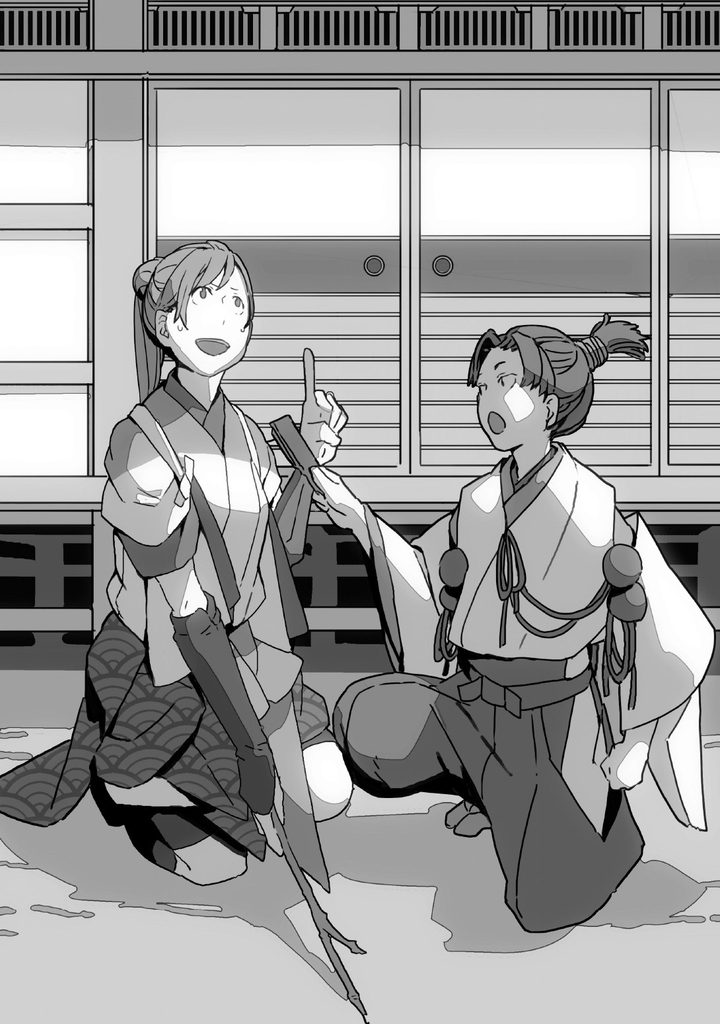
“…It is not from the Nanban lands, but in China…in Ming, there is a certain military treatise that has been passed down since ancient times.”
“A military treatise?”
Shizuko nodded as she spoke the name of a military text that contained universal principles of strategy transcending both culture and era.
“The name of that book is The Art of War by Sun Tzu.”
The Art of War by Sun Tzu.
It is a military treatise traditionally attributed to Sun Wu, a thinker of China’s Spring and Autumn period.
Although several thousand years have passed since it was written, it is still regarded as one of the finest works on strategy.
Of course, similar works also exist in the West.
There is On War by Carl von Clausewitz and The Art of War by Antoine-Henri Jomini.
Moving forward to a later era, there is also Strategy by Basil Henry Liddell Hart, a twentieth-century classic of military and strategic studies often mentioned alongside Clausewitz’s On War.
“In Ming, there are seven outstanding military texts in total, collectively known as the Seven Military Classics. Among them, this is the most famous.”
“Oho.”
“The Art of War, Wuzi, Weiliaozi, Six Secret Teachings, Three Strategies, Methods of the Sima, and Questions and Replies between Tang Taizong and Li Weigong. Each of them───”
“That matters not. Hurry and tell me about this『Sun Tzu』of yours.”
‘Tch, I couldn’t distract him…’
“Very well. As for Sun Tzu, allow me to quote some of its famous teachings.”
That was what Shizuko said, but in truth, she was not especially knowledgeable about it.
Originally, she had only read it because her older sister had asked her to buy it for her.
She had all of them stored on her smartphone as e-books but she had almost never gone out of her way to read them.
‘You really never know what will prove useful in life…’
“『If you know the enemy and know yourself, you need not fear the result of a hundred battles』,『Logistics are the lifeline of an army』and『To win without fighting is the supreme strategy』.”
“H-Hmm… Rather difficult… No, those are quite fine words!”
The boy nodded with a somewhat strained smile on his face.
He clearly did not understand them at all but Shizuko herself did not understand them all that deeply either, so she wanted to leave matters there.
Unfortunately, that hope was quickly shattered.
“So, what do they mean?”
“…『If you know the enemy and know yourself, you need not fear the result of a hundred battles』. It means that if you understand the true condition of your opponent and also understand your own circumstances, then even if you fight a hundred battles, you will not find yourself in peril.”
Shizuko dredged up from the depths of her memory the wording of an explanatory guide to The Art of War.
She had only read military texts because she had heard they influenced historical figures, so she very much hoped he would not question her too deeply.
Before the boy could think things over and voice another question, she moved on to the next explanation.
“『To win without fighting is the supreme strategy』. Winning one hundred battles out of one hundred is not the finest strategy. The finest strategy is to break the enemy’s will to fight without ever having to battle them.”
“I do not quite understand.”
“In short, the best outcome is to take the enemy’s country while keeping your own soldiers completely intact. Say you have forty thousand soldiers and your opponent has thirty thousand. Rather than wearing both armies down in battle before taking their country, wouldn’t it be better for the future if all forty thousand of your own soldiers remained intact while you still took their land?”
As she spoke, Shizuko wrote the numbers on the ground using kanji numerals.
“Just as an example, if you won without fighting and managed to absorb the enemy army intact, you would then have seventy thousand soldiers. If both sides fought until each army was reduced by half and you then won, you would have only thirty-five thousand soldiers. There are matters such as earning military merit to consider, of course, but wouldn’t it be better to avoid an unnecessary battle and increase the number of soldiers under your command?”
“Nggh… W-Well, that is certainly true…”
“Of course, there are times when one must fight. That is precisely why you should preserve your military strength as much as possible until then and commit your entire army when the truly decisive moment arrives. In the end, that results in fewer losses. And that brings us to the final teaching『Logistics are the lifeline of an army』.”
Shizuko continued her explanation while drawing a rough map on the ground.
“Let us say your country has enough provisions for fifty thousand men, while the enemy country has enough for forty thousand. Transporting all your provisions from your own country would require an enormous amount of expense. In that case, wouldn’t it be easier to obtain your provisions locally? In other words, it means a commander should endeavor to procure food from enemy territory whenever possible.”
“…H-Hmm…Do the Nanban and Ming truly put that much thought into warfare?”
At last managing to follow the explanation, the boy nodded with a deeply impressed expression.
The ideas were unfamiliar to him but perhaps because he was still a child, he did not show much resistance toward them.
It might also have helped that the boy was not yet a warrior himself, making him somewhat more willing to listen to Shizuko’s words.
“That was quite an interesting tale. I must return soon, so it is regrettable that I cannot ask you more.”
“I see. Then perhaps we can continue another time.”
Inwardly, Shizuko prayed there would never be another time but she could hardly say that aloud.
After all, although she had no idea exactly who he was, he was clearly the son of some warrior. Needlessly angering him would hardly be wise.
It was much easier to distinguish between her true feelings and what propriety demanded and simply offer the safest possible response.
“Indeed! By the way, what is your name?”
“…Shizuko. Um, if I may ask your na────”
“Shizuko, is it? I shall remember it. Then I hope our next meeting comes soon. Farewell!”
Shizuko had been about to ask the boy’s name, but before she could finish, he ran off somewhere.
Just as suddenly as he had appeared, he departed, vanishing from sight in the blink of an eye.
“…Is she not back yet?”
After lowering the hand she had awkwardly left hanging in midair, Shizuko muttered those words to herself.
Meanwhile, the boy was in exceptionally high spirits, humming cheerfully to himself.
He looked as though he might even start skipping when a certain person called out to him.
“What is it, Kimyo-Maru? You seem remarkably pleased with yourself.”
[Yes. 竹糖(ちくとう / chikuto) is a traditional Japanese sugarcane variety.]
[“mon” (文) = a unit of currency in premodern Japan. 250 mon is the price paid for one kin of sugar.
“kin” (斤) = a traditional unit of weight. In this passage, 1 kin is given as about 600 grams.]
[“Nata” (鉈) is a traditional Japanese heavy chopping blade—roughly like a billhook, machete, or small hatchet.]
[Genpuku (元服) is the traditional Japanese coming-of-age ceremony, especially for boys of the samurai class.]
[Kimyōmaru (奇妙丸) is a childhood name of Oda Nobutada, Nobunaga’s eldest son.]